Bike Domain Marketplace

Transforming Australia's Enthusiastic Motorcycle Community into a Modern Marketplace Platform

Bike Domain began as one of Australia's fastest-growing motorcycle content platforms, attracting over 100,000 monthly visitors through editorial content and an engaged rider community. As the audience grew, a recurring need became increasingly clear: riders and dealerships wanted a modern, trustworthy marketplace built specifically for motorcycles. The vision was ambitious—to create a platform capable of competing with established marketplaces such as BikeSales while providing a significantly better experience for both private sellers and professional dealerships. Rather than extending an existing CMS, the platform was designed from the ground up as a modern web application using Laravel and Vue.js, prioritising performance, scalability and long-term maintainability. I led the project from concept through production as the sole software engineer, designing the architecture, implementing the backend and frontend, modelling the database, building the marketplace workflows and delivering a production-ready platform within approximately three months.

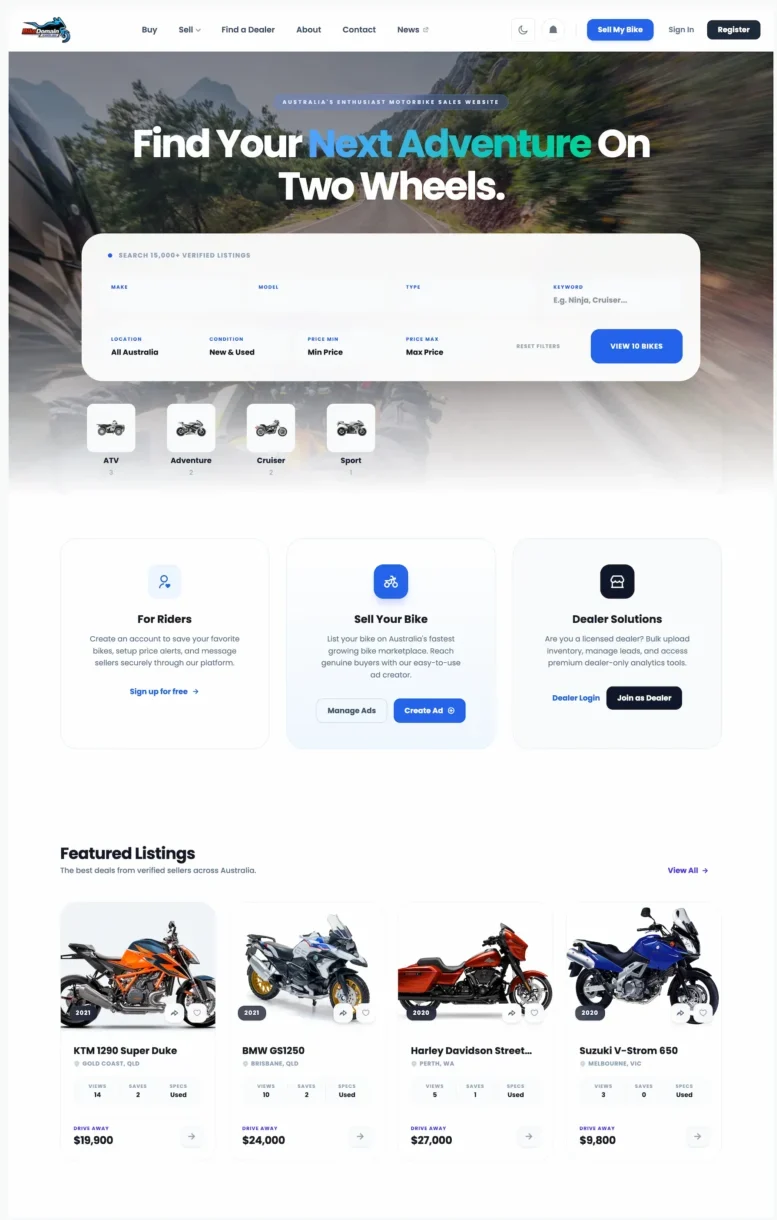
Bike Domain Homepage

Role

Sole Developer

Platform

Laravel, Vue, Stripe, Sanctum, TailAdmin

Timeline

3 Months

Engagement Type

Full Build

Overview

Bike Domain is a modern motorcycle marketplace platform designed to transform one of Australia's fastest-growing motorcycle communities into a premium buying and selling experience. Originally established as a successful content-driven website attracting more than 100,000 monthly visitors, the platform evolved into a full-featured marketplace to meet increasing demand from private sellers and professional dealerships.

The project involved designing and developing the platform entirely from the ground up using Laravel, Vue.js, TailAdmin, and MySQL, with a strong emphasis on performance, scalability, maintainability, and user experience. As the sole software engineer, I was responsible for every aspect of the product lifecycle, including system architecture, database design, backend development, frontend implementation, authentication, payment integration, deployment, and ongoing product evolution.

The completed platform provides dedicated dashboards for buyers, private sellers, dealerships, staff, and administrators, while supporting structured motorcycle listings powered by a reference database containing over 48,000 makes, models, and variants.

Challenge

The primary challenge was to create a marketplace capable of competing with established industry leaders while delivering a significantly faster, cleaner, and more intuitive experience for both casual users and commercial dealerships.

Unlike traditional classified websites, Bike Domain required a highly structured marketplace capable of managing complex relationships between motorcycle manufacturers, models, production years, technical specifications, dealerships, and marketplace listings. Every listing needed to remain consistent, searchable, and easy to manage while maintaining exceptional performance across desktop and mobile devices.

Another significant challenge was balancing flexibility with data integrity. Rather than allowing users to enter free-form vehicle information, the platform needed to guide sellers through a structured listing process that automatically populated technical specifications from an extensive motorcycle reference database. This approach would improve listing quality while enabling advanced filtering, analytics, and future platform expansion.

The project also demanded enterprise-level considerations such as secure authentication, payment processing through Stripe, phone verification via Twilio, role-based access control, and an architecture capable of supporting future growth without major structural changes.

Approach

Having previously developed a sophisticated motorcycle marketplace on WordPress, it became clear that the next generation of the platform required greater architectural freedom, improved database efficiency, and a more scalable application framework. Laravel was selected as the backend framework due to its clean architecture, expressive development experience, and long-term maintainability, while Vue.js was chosen to deliver a modern, responsive user interface without sacrificing performance.

The application was designed using a service-oriented architecture, where controllers remain lightweight and business logic is encapsulated within dedicated service classes. This approach promotes clean code, improves maintainability, and allows new features to be introduced with minimal impact on existing functionality.

Authentication was implemented using Laravel Sanctum, while the frontend combines static marketing pages with highly interactive dashboards built using TailAdmin. A carefully normalized relational database consisting of 33 interconnected tables powers the platform, including a comprehensive motorcycle reference library containing more than 48,000 makes, models, and variants.

The marketplace supports multiple user roles—including private users, dealerships, staff members, and administrators—each with dedicated workflows and dashboards tailored to their responsibilities. Stripe was integrated for secure payment processing, while Twilio provides phone verification to enhance platform security and reduce fraudulent activity.

Throughout development, the focus remained on creating a clean, scalable, and maintainable platform that could evolve alongside the business.

Outcome

Bike Domain successfully transformed an established motorcycle content platform into a modern marketplace capable of supporting thousands of structured listings while providing an exceptional experience for buyers, private sellers, dealerships, and administrators.

The resulting platform combines modern software architecture with a premium user experience, delivering fast search capabilities, structured motorcycle data, secure marketplace transactions, and dedicated management dashboards for every user type. The use of Laravel and Vue.js provided the flexibility to implement sophisticated business logic while maintaining excellent performance and long-term maintainability.

From an engineering perspective, Bike Domain demonstrates the successful delivery of a complex production platform as a solo engineering effort—from initial system architecture and database design through frontend development, backend services, payment integration, deployment, and continuous enhancement.

More importantly, the platform established a strong technical foundation for future growth, allowing new marketplace capabilities, integrations, AI-powered features, and additional business services to be introduced without requiring significant architectural changes.

Bike Domain represents the kind of software I enjoy building most—large-scale, user-focused platforms where thoughtful architecture, clean engineering practices, and long-term maintainability are just as important as delivering features.

Areas of Ownership

A structured view of the areas I owned end-to-end on this build—spanning architecture, frontend systems, performance, stability, and long-term maintainability.

Platform Architecture

  • Designed and engineered the platform architecture from the ground up using Laravel, Vue.js, and a service-oriented backend. Defined the database schema, authentication flow, API structure, role-based access control, and modular application architecture to ensure scalability, maintainability, and long-term extensibility.

Frontend Engineering

  • Built a responsive, modern user experience using Vue.js, TailAdmin, and component-driven design principles. Developed dedicated dashboards for private users, dealerships, staff, and administrators, focusing on usability, accessibility, and a premium user experience across desktop and mobile devices.

Performance & Stability

  • Engineered the platform with performance as a core principle through optimized database relationships, efficient queries, structured service layers, lazy loading, pagination, and scalable application design. Integrated Laravel Sanctum for secure authentication, Stripe for payments, and Twilio for phone verification while maintaining a stable, production-ready application.

Data & Marketplace Engineering

  • Designed a structured relational database containing over 48,000 motorcycle makes, models, and variants, enabling intelligent listing creation, standardized technical specifications, advanced filtering, and high-performance marketplace search. This data-first approach significantly improves listing quality while laying the foundation for future recommendation and analytics features.

Security & Integrations

  • Implemented secure authentication using Laravel Sanctum, integrated Stripe for payment processing, and Twilio for phone verification. Designed secure role-based access control, robust request validation, and protected marketplace workflows to ensure a safe and reliable experience for all users.

Solution

01

Discovery & Product Strategy

Every successful software platform begins with a clear understanding of the problem it aims to solve. Before development commenced, extensive planning was undertaken to define the marketplace's objectives, user journeys, business workflows, and long-term product vision.

Rather than creating another generic classifieds website, the goal was to build a premium motorcycle marketplace capable of serving private sellers, dealerships, buyers, support staff, and administrators through a single, scalable platform. This discovery phase established the foundation for the platform's architecture, database design, security model, and future roadmap.
02

Platform Architecture & Foundation

To deliver the flexibility, scalability, and maintainability required for a modern marketplace, the platform was architected using Laravel for the backend and Vue.js for the frontend. A service-oriented architecture was adopted, keeping business logic separate from controllers and ensuring the codebase remained modular, reusable, and easy to maintain.

Authentication was implemented using Laravel Sanctum, while clearly defined APIs, role-based permissions, and a structured database schema provided a robust technical foundation capable of supporting continuous product growth and future integrations.

03

Intelligent Motorcycle Database

One of the platform's defining capabilities is its structured motorcycle reference database containing more than 48,000 makes, models, and variants. Instead of relying on manually entered vehicle information, sellers follow an intelligent listing workflow that automatically retrieves technical specifications based on the selected motorcycle.

This approach standardizes marketplace data, improves listing quality, enables powerful search and filtering capabilities, and creates a reliable foundation for future features such as recommendations, analytics, and AI-driven search experiences.

04

Marketplace Experience

The marketplace was designed around the unique needs of its users, with dedicated dashboards and workflows for private sellers, dealerships, buyers, support staff, and administrators. Each experience was carefully crafted to simplify day-to-day operations while maintaining a clean, modern, and responsive interface.

From managing listings and inventory to tracking enquiries, moderating content, and administering the platform, every workflow was optimized to provide a seamless user experience across desktop, tablet, and mobile devices.

05

Secure Commerce & User Trust

Trust and security were treated as fundamental engineering principles throughout development. Secure authentication was implemented using Laravel Sanctum, while Stripe powers seamless payment processing and Twilio provides phone verification to help reduce fraudulent accounts and improve marketplace integrity.

Comprehensive request validation, role-based authorization, secure payment workflows, and carefully designed business rules ensure every interaction across the platform remains reliable, secure, and trustworthy.

06

Performance, Stability & Future Growth

Performance and long-term maintainability influenced every architectural decision throughout the project. Optimized database relationships, efficient queries, reusable service classes, pagination, and clean application structure ensure the platform remains responsive as new features and marketplace activity continue to grow.

By treating Bike Domain as a software platform rather than a traditional website, the resulting architecture provides a future-ready foundation capable of supporting additional marketplace services, AI-powered recommendations, advanced analytics, mobile applications, and continued business expansion.

05

Engineering Notes

Key engineering decisions and principles used to keep the platform fast, stable, and maintainable as requirements evolved.

Decision

Laravel Over a Traditional CMS

Rather than extending an existing CMS, the platform was built on Laravel to gain complete control over the application's architecture, database design, and business logic. This decision enabled a cleaner separation of concerns, improved developer experience, and greater flexibility for future marketplace features.

Principle

Structured Data Before Features

Instead of allowing free-form motorcycle listings, the platform was designed around a structured reference database containing over 48,000 motorcycle makes, models, and variants. Every listing references standardized vehicle information, ensuring consistency across the marketplace.

Tradeoff

Hybrid Frontend Architecture

The application combines server-rendered marketing pages with interactive Vue.js dashboards rather than adopting a fully server-side rendered or fully client-side architecture. This approach balances performance, development efficiency, and user experience while keeping the platform flexible for future enhancements.

Detail

Service-Oriented Backend Design

Business logic is encapsulated within dedicated service classes, keeping controllers lightweight and focused solely on request handling. This architecture improves code organization, simplifies debugging, and encourages reusable business logic across the application.

06

Results

Operational outcomes that reflect platform quality, stability, and delivery confidence.

Modern Marketplace Foundation

Successfully transformed an established motorcycle content platform into a modern, scalable marketplace application built using Laravel and Vue.js. The resulting architecture provides a strong technical foundation capable of supporting future marketplace features, integrations, and long-term business growth.

Structured Marketplace Data

Designed and implemented a normalized motorcycle reference database containing over 48,000 makes, models, and variants, allowing sellers to create highly structured listings while significantly improving data quality, search accuracy, and user experience.

End-to-End Product Delivery

Delivered the complete marketplace as a solo engineering effort, taking ownership of product architecture, backend services, frontend development, authentication, integrations, deployment, and ongoing platform evolution.

Multi-Role Marketplace Platform

Developed dedicated dashboards and workflows for private sellers, dealerships, staff members, and administrators, enabling each user group to efficiently manage their responsibilities through tailored experiences built around their daily workflows.

Enterprise Integrations

Integrated secure payment processing through Stripe alongside Twilio-powered phone verification, creating trusted marketplace workflows while reducing fraudulent listings and improving overall platform integrity.

Scalable Software Architecture

Implemented a service-oriented Laravel architecture with reusable business services, modular components, and secure REST APIs, enabling rapid feature development while maintaining a clean and maintainable codebase.

Tech Stack

Backend Engineering

  • Laravel 12 – Application framework powering the marketplace backend, APIs, authentication, and business logic.
  • PHP 8.x – Modern server-side language delivering high performance and excellent developer productivity.
  • Laravel Sanctum – Secure authentication for users, dashboards, and API communication.
  • Eloquent ORM – Elegant database relationships and query management.
  • Service Layer Architecture – Business logic separated into reusable service classes for maintainability.

Frontend Engineering

  • Vue.js 3 – Reactive frontend powering marketplace dashboards and user interactions.
  • Vite – Lightning-fast frontend tooling and asset compilation.
  • Tailwind CSS – Utility-first CSS framework for rapid UI development.
  • TailAdmin – Modern dashboard framework providing a clean administrative experience.
  • JavaScript (ES6+) – Dynamic user interactions and client-side functionality.

Database & Data Management

  • MySQL – Relational database powering the marketplace.
  • 33 Database Tables – Carefully normalized database supporting listings, users, dealerships, subscriptions, messaging, and marketplace workflows.
  • 48,000+ Motorcycle Records – Structured reference database containing makes, models, variants, and technical specifications.

Marketplace Features

  • RESTful APIs – Clean communication between frontend and backend.
  • Role-Based Access Control – Separate experiences for buyers, sellers, dealers, staff, and administrators.
  • Advanced Search & Filtering – Structured marketplace search built around standardized motorcycle data.
  • Listing Workflow Engine – Guided listing creation with automatic specification retrieval.

Payments & Integrations

  • Stripe – Secure online payment processing.
  • Twilio Verify – Phone verification and fraud prevention.
  • Email Notifications – Marketplace communication and transactional emails.

Development Workflow

  • Git & GitHub – Version control and source code management.
  • Composer – PHP dependency management.
  • NPM – Frontend package management.
  • VS Code – Primary development environment.
  • Responsive Design – Optimized for desktop, tablet, and mobile devices.